
Poverty has long been viewed as a major obstacle that prevents people from leading long, safe, healthy, and enjoyable lives.
It follows families across generations due to the hysteresis effect, meaning that poverty is influenced by past conditions – people who have been poor for a long time, in many cases, face limited access to new opportunities since they have consistently been denied these.
This is why eradicating poverty has been confirmed by the United Nations as the priority Sustainable Development Goal.
Recent decades have seen a significant decrease in global poverty, and several nations stand out for the innovative solutions that have helped to raise millions out of poverty.
Here, we present five nations that have implemented innovative, successful strategies to reduce poverty, with each taking a distinct approach.
To compile this list, we used data from the World Bank and Borgen Project.
 1. China
China’s transition from an agrarian, low-income country to the world’s second-biggest economy has helped to lift hundreds of millions of its citizens out of extreme poverty.
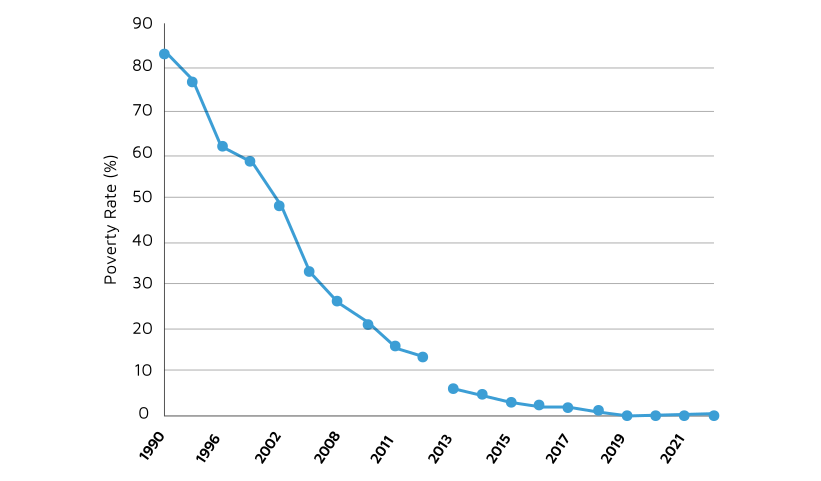
According to the World Bank, over a four-decade period (particularly during the 21st century), incomes in China have registered an impressive increase, helping around 800 million people who had been living on less than US$1.90/day which was the World Bank’s international extreme poverty line until 2022. Today, this metric stands at US$2.15, while for middle-income countries such as China, it is US$3.00 per day.
Share of the population living in poverty at $3.00 per day (2021 PPP) (1990-2022)
Source: World Bank
How did China tackle poverty?
Based on the report developed by China’s Ministry of Finance, the Development Research Center of the State Council, and the World Bank, the nation’s strategy to reduce poverty had two pillars at its foundation:
- A nationwide change in the economy to create new possibilities and boost average incomes.
- Anti-poverty programs in the poorest regions, with help being offered firstly to communities limited by geography and a lack of prospects, and then to individual households.
China placed a great deal of focus on education, investments in infrastructure, and competition support.
China had formally declared the end of absolute poverty by 2020, according to official sources.
Apart from the 800 million people lifted from extreme poverty in the era of reform, another 100 million people have managed to escape poverty in eight years of focused efforts to reduce poverty.
After officially ending extreme poverty, the focus has now shifted to long-term mechanisms rather than one-off activities, according to China Daily.
The government intends to incorporate poverty prevention into its rural revival policy, ensuring farmers have a steady and reliable income. This includes improved subsidies, pricing strategies, and insurance for agricultural producers.
 2. India
Today, India is the most populated nation in the world, exceeding 1.47 billion people, but only throughout the last few decades has it managed to tackle poverty and achieve some impressive results.
According to the United Nations, between 2005 and 2021, the Indian authorities were able to help 415 million people within its borders to escape poverty.
According to World Bank data, between 2011 and 2023, the percentage of people suffering extreme poverty in the country fell from 27.1% to 5.3%.
Share of the population living in poverty at $3.00 per day (2021 PPP) (1977-2022)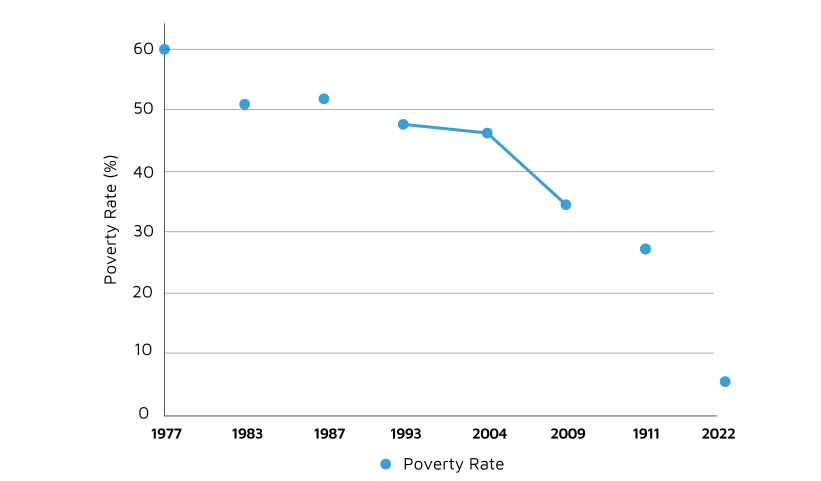
Source: World Bank
How did India tackle poverty?
The country’s success was possible due to bold state-level actions, such as food subsidies that helped to reduce poverty in all areas and among all demographic categories.
Here are just a few of the steps India has implemented:
- More than 400 million formerly unbanked people gained the ability to open a bank account thanks to the Aadhaar biometric ID and the Jan Dhan financial plan, which guarantee that the poor receive social benefits such as pensions and cooking gas subsidies.
Direct benefit transfers minimize corruption, resulting in more effective aid delivery.
- India placed a strong emphasis on basic necessities and sanitation. For instance, during the Swachh Bharat (Clean India) program, more than 100 million rural toilets were constructed in underdeveloped areas.
 3. Vietnam
Data from the World Bank suggests that over the last few decades, Vietnam’s GDP per capita increased by around 400% from US$596 in 1984 to US$4,018 in 2024.
In addition, during the same period, household income from wages registered an increase of around 300%.
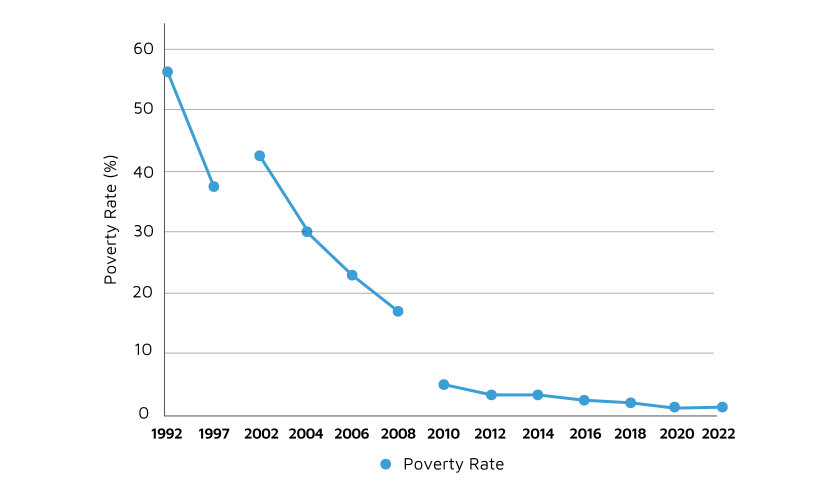
As a result, the poverty rate in Vietnam has dropped from around 60% of the population to just 1.9%.
Share of the population living in poverty at $3.00 per day (2021 PPP) (1992-2022)
Source: World Bank
How did Vietnam tackle poverty?
One of the major drivers of the positive change were the Doi Moi (Renovation) economic reforms – a detailed, systematic approach that emphasizes people.
The nation has made significant investments in healthcare, education, infrastructure, and human resource capability in both urban and rural areas.
Vietnam has achieved incredible results in poverty reduction since the start of its economic reforms in 1986.
As Vietnam made the shift from a centralized to a socialist-oriented market economy, the country registered rapid growth, benefiting even its most impoverished residents.
By implementing land reforms and supporting smallholder farmers, the government increased agricultural production and then encouraged industrialization, which led to an increase in the number of newly employed people.
In 1998, Vietnam’s Prime Minister Phan Văn Khải issued Decision No. 135/QD-TTg, which approved a program for socioeconomic development in mountainous and remote communities that faced severe hurdles. A great deal was invested in building roads, schools, and clinics, which ultimately led to a decrease in the poverty rate from 58% in 1993 to around 1.9% by 2022.
 4. Indonesia
With 280 million inhabitants dispersed across more than 17,000 islands, Indonesia is the largest archipelagic state in the world. During the 21st century, it has achieved notable results in reducing poverty.
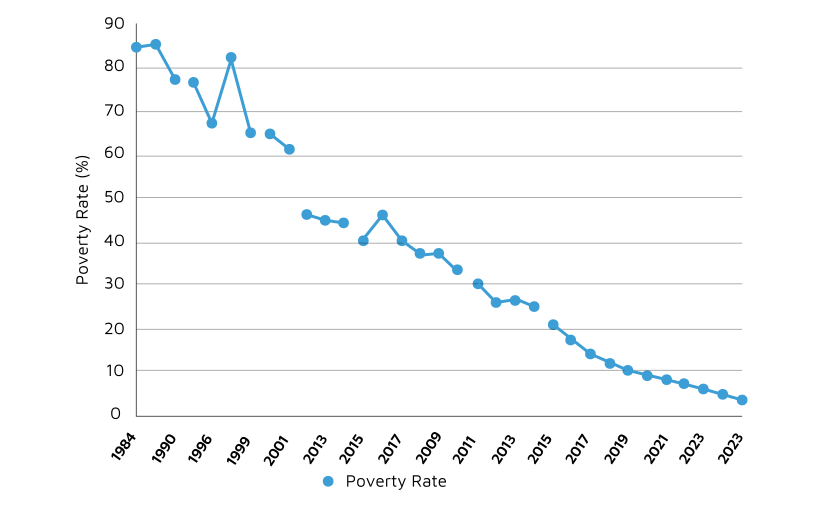
In 2024, the poverty rate dropped to an all-time low of 9%, pulling nearly 3 million people out of poverty.
Currently, urban poverty stands at 7.1%, while rural poverty is at 11.8% – a remarkable difference compared to the rural poverty rates of 83% registered four decades earlier in 1987.
Share of the population living in poverty at $3.00 per day (2021 PPP) (1984-2025)
Source: World Bank
How did Indonesia tackle poverty?
One of the major reforms undertaken by the Indonesian authorities involved economic investment packages to diversify rural income beyond agriculture.
For instance, in the summer of 2025, two major investments totaling US$2.1 billion in a blended finance package were approved by the World Bank to increase employment, stimulate economic development, and improve access to sustainable energy in Indonesia.
Another reform aimed to spend 20% of the national budget on education, which ultimately enhanced access, gender parity, and employment prospects.
The nation hopes to eradicate poverty by the time it celebrates its centenary, according to the Golden Indonesia 2045 Vision.
 5. Bangladesh
Bangladesh is home to 174 million people. The country has achieved great progress in education and workforce development, improving literacy rates and opening up new job prospects, explained Eléonore Bonnaterre from Borgen Project.
The nation is an impressive illustration of how partnerships and local innovation can promote long-term poverty eradication. Over 33 million people have been brought out of extreme poverty in this South Asian country since 2000.
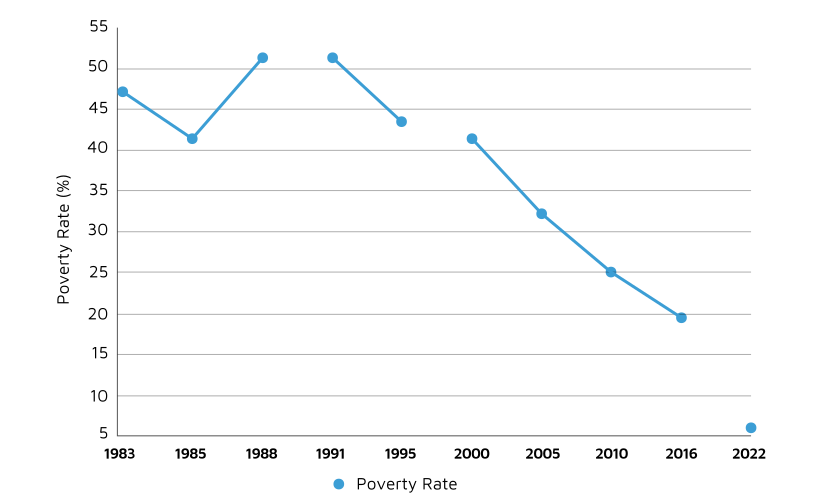
Data from the World Bank shows that in 2000, the poverty rate in Bangladesh was over 41%, whereas in 2022 it stood at 5.9%.
Share of the population living in poverty at $3.00 per day (2021 PPP) (1983-2022)
Source: World Bank
How did Bangladesh tackle poverty?
Even though the nation is still among those that struggle the most in the world, it has made significant strides in two crucial areas: workforce development and education.
- In 2022, the country’s literacy rate reached 79%, according to the World Bank data, which is three percentage points over the previous year and a significant increase from the 59% registered in 2011.
- Bangladesh has prioritized job creation, investing significantly in its tourism industry, according to the United Nations. The industry is creating jobs in retail, food services, transportation, and handicrafts.
- Bangladesh’s community-based programs have reduced child mortality, while programs involving stipends for girls’ education have reduced gender disparities.
- Millions of job opportunities for low-income workers have been created thanks to the growth in the economy, which is driven by the clothing export sector and foreign remittances.
According to the Economic Observatory, Bangladesh is currently the second largest exporter of clothes, behind China.
Although there is still more progress to be made, the nation’s path demonstrates the strength of social innovation and resiliency in the face of obstacles such as a dense population and natural disasters.
Final word
This list offers just a few examples of countries that have revolutionized social support systems, and investments in education, and implemented a mix of approaches to manage poverty reduction.
Investing in people (jobs, health, and education), directing aid toward the most vulnerable, and enabling communities to take part in their own growth are some of the common elements.
Naturally, these countries still face various challenges, and there remains a long way to go, but nevertheless, their remarkable results cannot be denied.
These examples prove that if a nation has the political will, implements wise policies, and business, civil society, and government work together as one entity, it is possible to create new gains in the battle against poverty.
